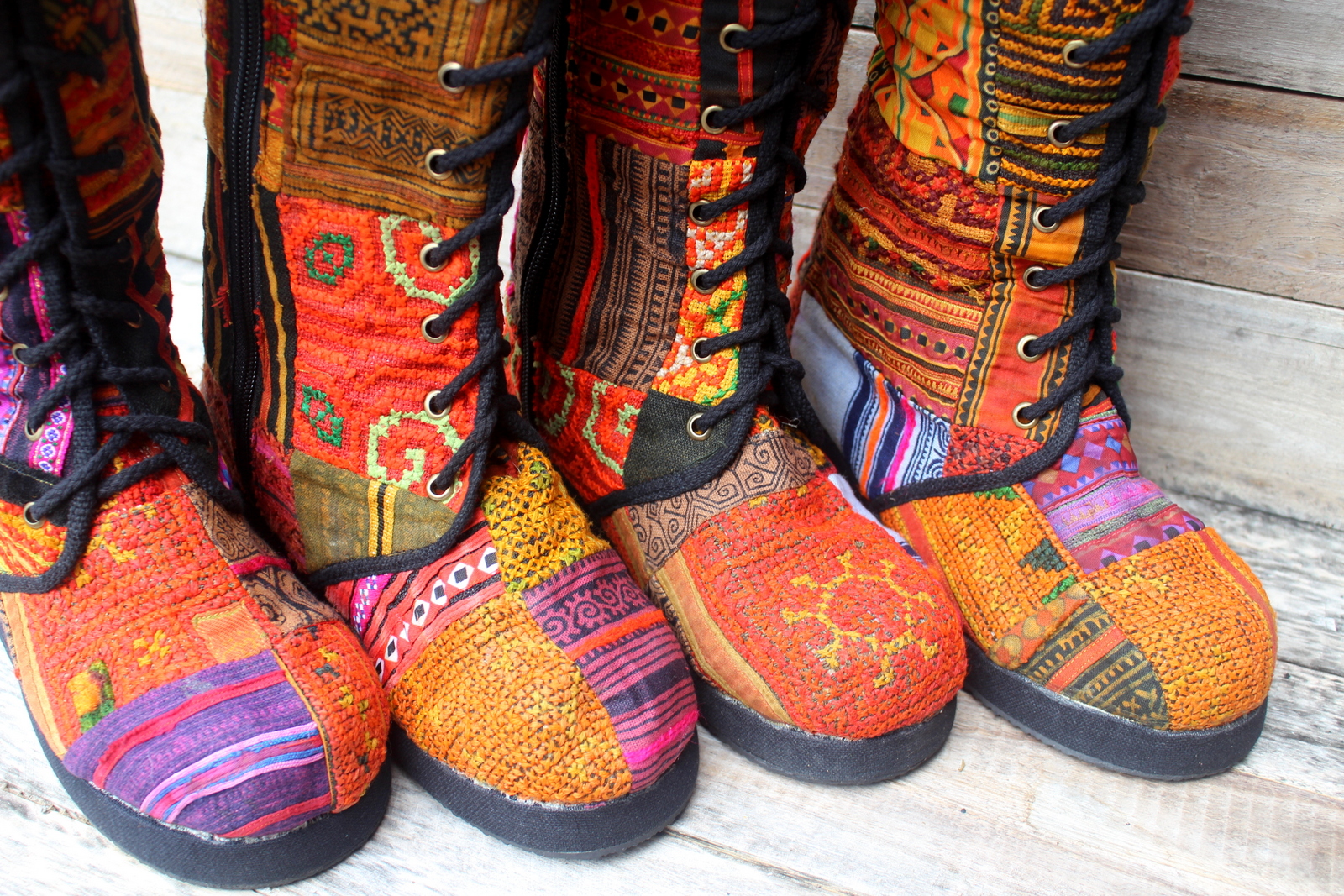
Ethical Fashion doesn't have to be boring

Tuesday, February 3, 2015

Teen Jok Hand loom weaving
photo credit http://tribaltrappings.blogspot.com/2012_02_01_archive.html

Teen Jok

Mae Chaem Thailand
Sunday drives in the mountains here in Thailand are often an exciting treasure hunt for a couple of textile junkies like us.Nestled in a quiet valley in the mountains of northern Thailand we found Mae Chaem, and the gorgeous Teen Jok textiles.
This sleepy little valley town was celebrating their textile heritage with their annual ‘Teen Jok Festival’. Just like a county fair back home there were beautiful displays and ribbons awarded for the best of show.

We had been familiar with another textile that goes by a similar name, however that one is machine made. Here the Tai Yuan people are known for creating stunning hembands ('teen') on their traditional skirts ( 'phaa sin') using the technique of discontinuous supplementary weft weaving ('jok). Often referred to as “embroidery on a loom”, this technique requires that different colored weft threads be inserted, threaded and picked through the warp threads, thus forming colorful patterns. Sometimes the picking is done with porcupine quills. 
Teen Jok textiles


Many of the hilltribes were also present  dressed  in their traditional clothes and showing off a bit  of their own textile art.


But Teen Jok was the star  of the day and you could feel the pride of the villagers in their textile legacy.
You will be seeing more of teen jok in our future designs. 
Today let me introduce you to these colorful mens neckties. Perfect for those special men who just won't settle for ordinary.


Barbara


Thursday, October 24, 2013

What's In A Name


What's In A Name

We have been working on our new children’s line of clothing and footwear for many months. There can be a lot of bumps in the road when you are making a brand new line of products. We finally have enough little shoes and boots, dresses and pants to go ahead and present our ideas to the world. Wait, we need a name for all this adorable little stuff. We thought about using something like "Boho Babies", no we are not really making baby things and a 5 year old might just not be happy being called a baby. "Tribal Tots", hmmm, but we go up to larger sizes that are no longer tots.

DekDoi, as soon as the words came out of Amy’s mouth we both knew this was it.

When we travel to the villages in the mountains often we are there in the afternoons. This is the time the children come out to play. It is such a pleasure to watch these children and their simple methods of play. No electronics, no fancy toys or computers to occupy their time. They run, rocks and pebbles turn into games in the dirt. It’s simple, they are breathless with joy as they speed up and down the hills. Mothers chatting close by with friends while working on their latest embroidery, babies, lots of babies. It’s simple, it’s natural, it’s slow and it is pure joy to watch. Dek Doi means mountain child, it was perfect. Young, wild, free.
So we gathered up some friends, several cameras, a few small children with parents
 in tow and headed out to the country. Thank you Charlotte for living in paradise. An old teak-wood house, mountains, a lake and lots of room for kids to run. 


The children played and the photographers shot as they… well did what children do. 

A blanket, some bubbles, a guitar played by our dear friend Thon and a great day was had by all.


Introducing DekDoi
(Mountain Child)
 by Siamese Dream Design


A friendly neighbor even stopped by to see what we were up to.

A giant thank you to all of our friends who helped make this day possible. We truly love you.

Visit the Children's Shop on Siamese Dream Design to see all of the new children's styles.
 Ethnic fashion for the smaller set. 

Barbara

Tuesday, September 17, 2013

History In A Pair Of Boots

Vintage Hmong patchwork womens boots


History In A Pair Of Boots

All those little squares of Hmong embroidery, batik and appliqué, each with a unique story. A tale of the Hmong woman who created it long ago. Batik and embroidery skills are passed down from mother to daughter. In Hmong history most girls sewed their own clothes. The girls first learn to embroider, followed by appliqué and then batik.


Some women start with the cotton fiber grown in their own fields, spin the fiber, and weave the cloth, sometimes in intricate patterns. This is just the beginning. Natural indigo and other dye plants are grown, gathered, and prepared. The cotton is dyed in the indigo vat numerous times to create a deep, almost black, color. 


For the Hmong New Year’s celebration they still dress up in their best embroidered clothes to be seen in public with friends, and enjoy courtship games of ball tossing with boys. On New Year’s Day, a Hmong family wears their new clothes to celebrate the festivities. This is believed to bring good luck, health and prosperity.


Great time and love goes into making baby carriers and hats that act as talismans to protect the child. Embroidered symbols chosen for good health and fortune, while bells and pom-poms ward off evil. 
The Butterfly Mother is important in the creation mythology of the Hmong (Miao), so the butterfly symbols used on baby carriers hold specific importance. The legend tells that the gods created the earth and planted many maple trees. A butterfly flew from one maple tree and laid 12 eggs. One of the eggs hatched and gave birth to Jian-ian, who gave humans the ability to procreate. The butterfly is therefore the creator of all living beings bringing children good luck and health, while granting women the power of fertility.


http://www.siamesedreamdesign.com/apps/webstore/products/show/4073186

So when I look at our Hmong patchwork boots, I will think of the women’s stories behind every one of those pieces of textile art.  


Barbara 

Thursday, June 6, 2013

A Genuine Hill Tribe Experience In Thailand

We are getting ready to welcome my younger sister and her daughter to Thailand for the first time. Needless to say we are excited. The planning of activities has taken me to consider my past 13 years in this beautiful, chaotic and richly diverse country. One of the things that is top of my list to show her is a real hill tribe village with real hill tribe people. Not the tourist trap make believe places that most visitors go to see with imported Chinese trinkets on sale. Not the villages showing old style life on the surface and hiding the more modern elements of their life from the tourists. A real village, one that is modernizing and still preserving their old cultural ways. A village that is learning to balance the old and the new.
There is a Hmong village high in the mountains here that grows and weaves organic hemp the old way while running an organic coffee plantation. It is located well past where most tourists venture and life there is much the same as it has been for the Hmong for decades. Yet they are running a coffee plantation and soon to open an Eco Lodge.
Mountains of northern Thailand

Hmong woman weaving
Weaving

Grinding corn the traditional way
Young Hmong boy with his crossbow

Putting the kettle on in the Hmong village
Growing indigo for natural dye

Young Hmong women with their embroidery


We should definitely take her to see the proud Akha headwoman we know. Disheartened by the scattering of her people who have moved near the city to earn money, she is creating a new village just outside the city of Chiang Mai where they can once again come together. A place for the women to sit, sew and talk like in the old days. At the same time she is creating a gathering place for their beautiful textiles old and new. A museum of sorts as well as a place for new pieces to be distributed and sold creating income while preserving these age old skills. She is the one who taught us about the old Akha symbols in their appliqué and needlework. 

Vintage Akha headman embroidered and appliqued jacket
Old Akha bone necklace to ward off bad spirits


Akha tribal opium knife symbols on ivory cushions / pillows


Already on the agenda are a couple days in the mountains with our Karen friends. About a three hour journey from modern Chiang Mai we will do a little bamboo rafting, a visit with the elephants and then on to their Karen village. 
Bamboo rafting in northern Thailand


If you plan to visit elephants while you are in Thailand, please choose a responsible location that is kind to these beautiful creatures. May we suggest 

http://http/www.elephantnaturepark.org/index.htm


We are excited to see and talk with the Karen sisters and aunties to show my sister their traditional weaving. Our latest batch of Karen shirts has us very excited so we will be more than happy to have the opportunity to acquire more of these colorful pieces.


So we will attempt to show her a small glimpse of the eclectic sights and genuine experiences we have had the unique opportunity to experience.

 Barbara

Thursday, April 11, 2013

Songkran Daze in Chiang Mai


Happy Songkran Everyone

It has begun. The biggest water fight in the world and we are in the center of it here in Chiang Mai, the capital of Songkran. It’s a wild festival and really needs to be seen to be believed. Massive water fights break out all across the country and it makes you feel like a kid again.

It is the Thai New Year. It’s a time for cleansing and a time for renewal. The water washes away all the bad so you can start the year fresh, clean from all that is wrong in the world. 
It’s a happy time of the year where complete strangers can dump water over each others heads and smile about it. It’s an amazing experience and the rest of the world could learn a lot from it. It’s not uncommon for people to throw water at the Police and the Police take it with a smile.  


It’s a Buddhist festival. People bring sand to the temples  in order to replace the dirt that they have carried out with feet  in the past year.The sand is shaped into little stupas— miniature sand-sculptures  which  you can view at temples during  the Songkran festival. Buddha statues are paraded through the streets in order for people to pour water over them, respectfully
 “bathing” the holy images. 


Throughout the festival, a strong emphasis is placed on renewing traditional family values by showing respect and deference to elders. This is where the practice of throwing water comes from; it began by pouring scented water on the hands of elders to show respect and ask for blessings for the new year. 


For the next 5 or 6 days Thailand will stop to play, to wash away their troubles and worries. In Chiang Mai traffic will not move, trucks will be decked out with colorful powders and paint, giant tubs and trash cans will be filled with water and blocks of ice, if you go out you will get wet. People will play like children, they will laugh and dance, there will be parades, concerts and respectful temple ceremonies, food, family, friends and Thailand will smile. 

Amy and her crew are ready to go.

Did I mention the average daily temperature right now is 107/42


Happy New Year everyone. Sawadee Bee Mai.