Ethical Fashion doesn't have to be boring
Showing posts with label Hmong. Show all posts

Tuesday, September 17, 2013

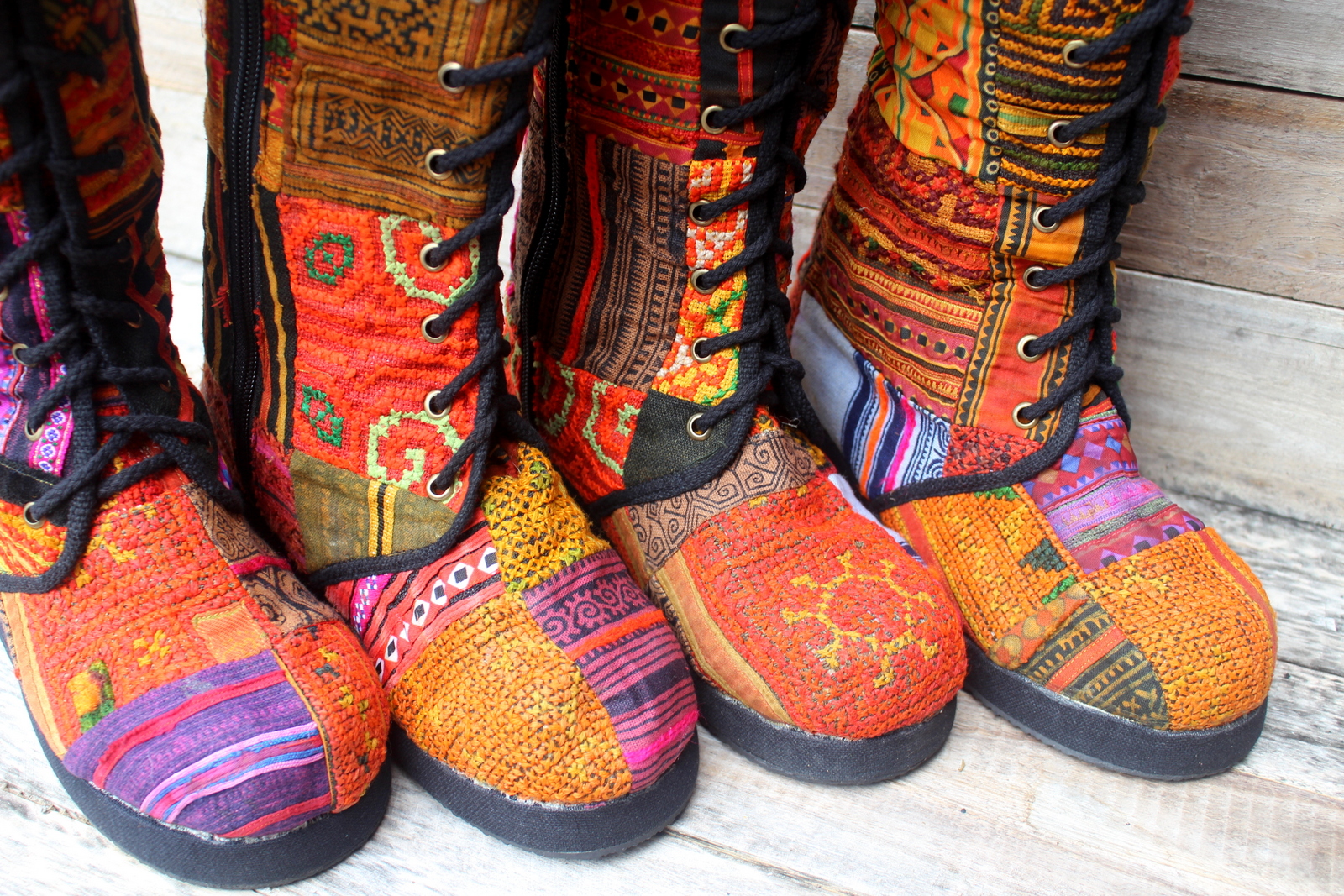
History In A Pair Of Boots

Vintage Hmong patchwork womens boots


History In A Pair Of Boots

All those little squares of Hmong embroidery, batik and appliqué, each with a unique story. A tale of the Hmong woman who created it long ago. Batik and embroidery skills are passed down from mother to daughter. In Hmong history most girls sewed their own clothes. The girls first learn to embroider, followed by appliqué and then batik.


Some women start with the cotton fiber grown in their own fields, spin the fiber, and weave the cloth, sometimes in intricate patterns. This is just the beginning. Natural indigo and other dye plants are grown, gathered, and prepared. The cotton is dyed in the indigo vat numerous times to create a deep, almost black, color. 


For the Hmong New Year’s celebration they still dress up in their best embroidered clothes to be seen in public with friends, and enjoy courtship games of ball tossing with boys. On New Year’s Day, a Hmong family wears their new clothes to celebrate the festivities. This is believed to bring good luck, health and prosperity.


Great time and love goes into making baby carriers and hats that act as talismans to protect the child. Embroidered symbols chosen for good health and fortune, while bells and pom-poms ward off evil. 
The Butterfly Mother is important in the creation mythology of the Hmong (Miao), so the butterfly symbols used on baby carriers hold specific importance. The legend tells that the gods created the earth and planted many maple trees. A butterfly flew from one maple tree and laid 12 eggs. One of the eggs hatched and gave birth to Jian-ian, who gave humans the ability to procreate. The butterfly is therefore the creator of all living beings bringing children good luck and health, while granting women the power of fertility.


http://www.siamesedreamdesign.com/apps/webstore/products/show/4073186

So when I look at our Hmong patchwork boots, I will think of the women’s stories behind every one of those pieces of textile art.  


Barbara 

Thursday, June 6, 2013

A Genuine Hill Tribe Experience In Thailand

We are getting ready to welcome my younger sister and her daughter to Thailand for the first time. Needless to say we are excited. The planning of activities has taken me to consider my past 13 years in this beautiful, chaotic and richly diverse country. One of the things that is top of my list to show her is a real hill tribe village with real hill tribe people. Not the tourist trap make believe places that most visitors go to see with imported Chinese trinkets on sale. Not the villages showing old style life on the surface and hiding the more modern elements of their life from the tourists. A real village, one that is modernizing and still preserving their old cultural ways. A village that is learning to balance the old and the new.
There is a Hmong village high in the mountains here that grows and weaves organic hemp the old way while running an organic coffee plantation. It is located well past where most tourists venture and life there is much the same as it has been for the Hmong for decades. Yet they are running a coffee plantation and soon to open an Eco Lodge.
Mountains of northern Thailand

Hmong woman weaving
Weaving

Grinding corn the traditional way
Young Hmong boy with his crossbow

Putting the kettle on in the Hmong village
Growing indigo for natural dye

Young Hmong women with their embroidery


We should definitely take her to see the proud Akha headwoman we know. Disheartened by the scattering of her people who have moved near the city to earn money, she is creating a new village just outside the city of Chiang Mai where they can once again come together. A place for the women to sit, sew and talk like in the old days. At the same time she is creating a gathering place for their beautiful textiles old and new. A museum of sorts as well as a place for new pieces to be distributed and sold creating income while preserving these age old skills. She is the one who taught us about the old Akha symbols in their appliqué and needlework. 

Vintage Akha headman embroidered and appliqued jacket
Old Akha bone necklace to ward off bad spirits


Akha tribal opium knife symbols on ivory cushions / pillows


Already on the agenda are a couple days in the mountains with our Karen friends. About a three hour journey from modern Chiang Mai we will do a little bamboo rafting, a visit with the elephants and then on to their Karen village. 
Bamboo rafting in northern Thailand


If you plan to visit elephants while you are in Thailand, please choose a responsible location that is kind to these beautiful creatures. May we suggest 

http://http/www.elephantnaturepark.org/index.htm


We are excited to see and talk with the Karen sisters and aunties to show my sister their traditional weaving. Our latest batch of Karen shirts has us very excited so we will be more than happy to have the opportunity to acquire more of these colorful pieces.


So we will attempt to show her a small glimpse of the eclectic sights and genuine experiences we have had the unique opportunity to experience.

 Barbara

Sunday, October 23, 2011

Dying textile traditions in the mountains of South East Asia


She’s lived in these mountains for as long as she can remember, but it's all different now.  Now there are roads and shops and the young people are leaving. They are leaving for the cities, for factory jobs and tourist spots. They are leaving without the tribal skills, the skills which they did not care to learn. The skills they felt would not provide the things people down there, in the city value. The skills her grandmother taught her mother, and her mother taught her and she taught her daughter. "Is this where it ends?" she wonders.
Yet she smiles as she sits in her hut and draws the batik as she has for years. It is a part of her, the culture, the Hmong tribal ways. The women sitting together embroidering, chatting, after a day of gathering or planting in the hills. Will it end here? These beautiful skills lost forever remembered only by these hills that witnessed the beauty of it, and the grandmothers that created them.